Truck accidents in New Jersey are among the most devastating incidents on our roads, often resulting in severe injuries or fatalities. Given the state's dense population and extensive highway system, including major routes like the New Jersey Turnpike and Garden State Parkway, the risk of such accidents is significant. If you or a loved one has been involved in a truck accident, understanding your rights and the legal avenues available is crucial.
Truck accidents are among the most severe types of crashes on New Jersey’s roadways. Due to the sheer size and weight of commercial trucks, especially when loaded, these accidents often result in devastating injuries, significant property damage, or fatalities. Understanding the primary causes of truck accidents not only helps establish liability after a crash but also highlights the importance of safer practices in the transportation industry.
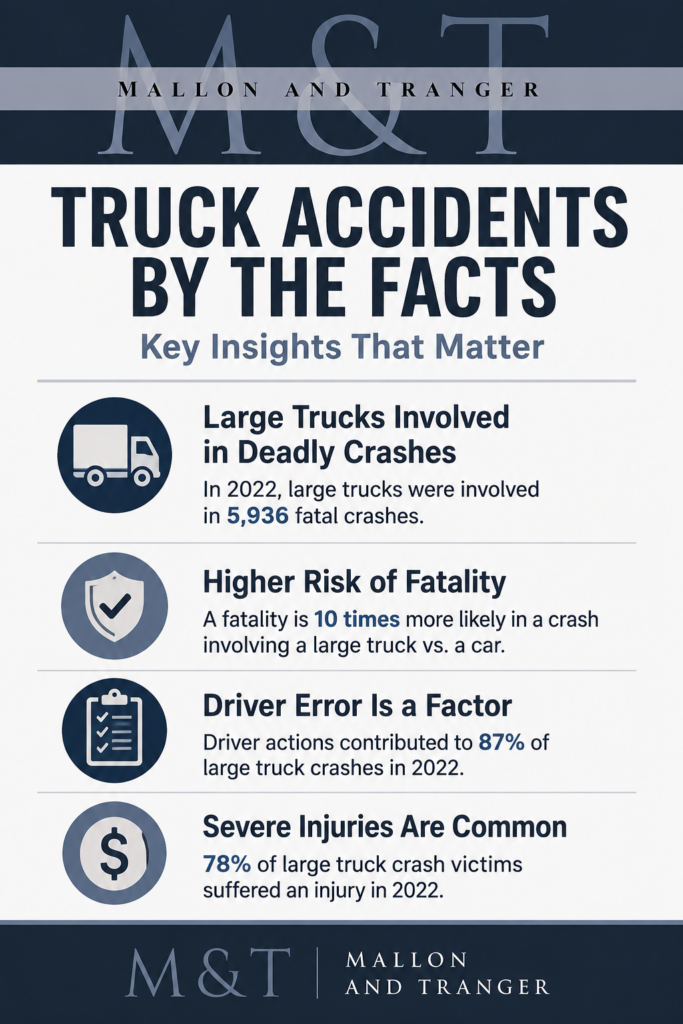
According to the New Jersey Department of Transportation, thousands of large truck crashes are reported each year. In 2023, there were over 4,000 truck-related crashes on New Jersey highways, including 55 fatal crashes involving trucks.
Truck accidents in New Jersey are not random; they often follow specific patterns based on time of day, location, and road conditions.
Truck accidents are especially common in the following locations:
The New Jersey State Police report that the top five reasons that fatal truck accidents occur are:
At Mallon and Tranger, we understand the unique dynamics of truck accident cases and the many factors that contribute to these catastrophic events. Whether your accident happened on the Turnpike, a local roadway in Howell, or a highway near Toms River, we will thoroughly investigate every possible cause and build a case that holds negligent parties accountable.
Tractor-trailers, semis, and commercial trucks are obviously much larger than other vehicles, but that is not the only reason that a truck accident case differs from a regular car accident case.
The major legal difference is that truck drivers are subject to a variety of rules and regulations that likely do not apply to the average car driver. These regulations can include things like:
A violation of any of these rules could help you prove liability in a truck accident case. If you attempt to assert your rights in a truck accident case alone, you may not realize that the driver has these restrictions or when they have been violated. Overlooking these regulations can lead to lower settlements or an unfavorable legal outcome.
There are some key logistical differences that deal directly with the truck’s size as well, including slower acceleration and longer stopping distance. These factors can result in accidents that would not have occurred in a smaller vehicle.
Another major difference is the insurance company you would have to deal with. It is possible that you would have to talk to not only the driver’s insurance company but also his or her employer’s insurance company.
You may even have to deal with a different insurance company if another party actually owns the truck. The truck manufacturer may also come into play. All of these potential parties add a unique level of complication to this type of truck accident case.
Truck accidents are vastly more destructive than standard vehicle collisions. A fully loaded commercial truck can weigh up to 80,000 pounds, and when it collides with a smaller passenger vehicle, the injuries and physical trauma are often catastrophic. Victims frequently suffer life-altering injuries, long recovery times, and permanent disabilities, especially in high-speed collisions or multi-vehicle pileups on New Jersey highways like I-78, I-295, and the New Jersey Turnpike.
At Mallon and Tranger, we’ve represented clients across Freehold, Monmouth County, and beyond who have suffered devastating injuries after truck crashes. Below are some of the most common injuries we see and why prompt medical and legal attention is essential.
Many of these injuries, especially internal damage, TBIs, or emotional trauma ,may not present obvious symptoms immediately after the crash. That’s why it’s crucial to:
At Mallon and Tranger, we work closely with medical experts to evaluate, document, and present injury evidence that supports your case. Whether your injuries occurred in a collision on the New Jersey Turnpike, in Oakhurst, or on a rural road near Howell, our team of attorneys is here to fight for the compensation you need to recover physically, emotionally, and financially.
Establishing liability in a New Jersey truck accident is more complex than in a typical car crash. That’s because trucking operations often involve multiple individuals and entities, each with different legal responsibilities. When a serious truck accident occurs on roads like the New Jersey Turnpike, I-295, or Route 130, determining exactly who is at fault requires thorough investigation and legal analysis.
Related: Evidence needed for your truck accident claim
In many cases, more than one party may be responsible for the accident. Under New Jersey’s comparative negligence laws, fault can be shared among multiple parties, and each is held liable in proportion to their role in causing the crash. As long as a victim is found to be less than 51% at fault, they may still recover damages, though their award will be reduced by their percentage of fault.
Here’s a breakdown of the most common parties who may be held liable:
Truck drivers can be directly liable if they acted negligently or recklessly behind the wheel. Common examples of driver negligence include:
In many New Jersey truck accident cases, the driver’s own conduct is the first area of scrutiny. If a driver fails to follow traffic laws or safety standards, they can be held personally liable.
Trucking companies have a legal duty to ensure safe hiring, training, and supervision of their drivers, as well as to maintain their fleets properly. They may be liable for:
In many New Jersey truck crash lawsuits, trucking companies are named as defendants under the doctrine of vicarious liability, meaning they are responsible for the acts of their drivers performed within the scope of employment.
Improperly loaded or secured cargo is a major cause of truck accidents, particularly rollovers, jackknifes, or spilled cargo that causes secondary collisions. Liability may fall on third-party contractors or loading personnel when:
In warehouse hubs like Elizabeth, Newark, or South Jersey, these accidents often happen when goods are hastily loaded during high-volume delivery cycles.
When a mechanical failure or defective part plays a role in a crash, the truck or parts manufacturer may bear responsibility. This is known as product liability and can involve defects such as:
If a manufacturing defect caused or worsened the accident, victims may pursue a claim against the vehicle manufacturer or parts supplier.
Sometimes, the company responsible for maintaining or servicing the truck contributes to the crash by failing to identify or correct dangerous mechanical issues. This may involve:
These third-party service providers may be held liable if their negligent repair or oversight directly led to the collision.
In some cases, additional parties may share liability, such as:
Under New Jersey’s comparative negligence rule (N.J.S.A. § 2A:15-5.1), each party’s share of liability impacts the final compensation award. For example:
This rule makes it crucial to work with an experienced New Jersey truck accident attorney who can:
At Mallon and Tranger, we conduct thorough investigations using crash reports, black box data, driver logs, maintenance records, and expert analysis to determine who should be held accountable. Whether your accident occurred in Monmouth County, Ocean County, or any major New Jersey highway, we are committed to building a strong case and helping you secure the full compensation you deserve.
The aftermath of a truck accident is often overwhelming. Victims face severe injuries, mounting medical bills, lost income, and pressure from insurance companies. Unlike typical car accidents, truck crashes usually involve multiple liable parties, federal and state regulations, and complex evidence such as black box data and service logs. Without legal guidance, important details can be missed, and victims may settle for far less than they deserve.
At Mallon and Tranger, our New Jersey truck accident attorneys have the resources, experience, and dedication needed to thoroughly handle your case and protect your rights.
We conduct an in-depth investigation to uncover the full story behind your crash. This may include:
These steps are critical to building a solid foundation for your claim.
Truck accident cases often involve more than just the driver. We work to identify every responsible party, including:
By identifying all liable parties, we help you pursue maximum compensation from all available insurance policies.
Insurance carriers representing trucking companies are aggressive and often have teams of adjusters and defense lawyers working to minimize payouts. We protect you by:
We don’t let insurers take advantage of our clients, especially during such a vulnerable time.
While many cases settle out of court, we are fully prepared to take your case to trial when needed. Litigation may be required if:
Our attorneys will represent you confidently before a judge or jury and fight for the compensation you deserve.
Every truck accident case is unique, but victims in New Jersey are often entitled to compensation for a wide range of damages, including:
We work with injured victims throughout Ocean County, Monmouth County, and all of New Jersey in a wide array of personal injury cases, including:
At Mallon and Tranger, we work closely with medical providers, financial experts, and accident investigators to document every aspect of your loss and pursue the full value of your claim. If you have lost a loved one in a New Jersey truck accident, our team is also here to help you pursue damages in a wrongful death lawsuit.
If you or a loved one has been injured in a truck accident in New Jersey, you don’t have to handle the legal system alone. Trucking companies and their insurers act fast to limit their liability and you should have someone on your side who acts just as quickly and aggressively to protect your interests.
At Mallon and Tranger, we understand how devastating a truck crash can be. We’ve helped clients across Freehold, Point Pleasant, and throughout the state get the compensation they need to move forward after life-changing collisions.
If you've been injured in a truck accident or lost a family member in a fatal crash, call Mallon and Tranger today at 732-780-0230 or connect with us online to schedule a free, no-obligation consultation.
Reviewed for legal accuracy by Thomas J. Mallon on September 9, 2026
Truck accident cases often involve commercial insurance, federal rules for semi-truck operators, and multiple potentially liable parties like the motor carrier, shipper, or maintenance provider. We apply New Jersey law while using federal safety rules to show negligence, then build your claim around black box data, logs, and fleet policies. If your crash happened in Freehold or Point Pleasant, our attorney team investigates every angle specific to a semi-truck collision in New Jersey to pursue full compensation.
Most personal injury claims, including those from a truck accident, must be filed within two years in New Jersey, but there are exceptions for certain situations. Because evidence from a semi-truck can be overwritten or lost quickly, we start preservation efforts immediately and track every deadline. If your wreck occurred near Freehold or Point Pleasant, our attorney team will calculate the exact timeline that applies to your case under New Jersey law.
Liability can extend to the motor carrier, maintenance contractors, and sometimes shippers depending on control and safety duties. Carriers must maintain driver qualification files containing applications, medical certifications, and other compliance documents. Hours-of-service records and electronic logging data can show fatigue or rule violations. Maintenance and inspection records help establish whether mechanical issues were ignored. Your attorney will request these records and evaluate them with crash reconstruction. Federal safety rules provide a roadmap for what to seek and how to interpret it.
Key sources include the truck’s electronic logging device data, engine control module data, and any dashcam or inward-facing camera video. Carriers use ELDs to record driving time and duty status and must comply with federal hours-of-service rules. Prompt preservation letters help prevent routine overwriting. Supporting documents like fuel, toll, and GPS records can corroborate timelines. Your attorney will also seek dispatch communications that reflect scheduling pressures. Acting quickly ensures compliance data is available for expert analysis.
These rules set maximum driving and on-duty hours and require specific rest periods. Violations can support claims that a driver was fatigued and operating unsafely. ELD and supporting records help verify compliance. Carriers are obligated to ensure their drivers follow these rules and to maintain relevant records. A documented violation can strengthen negligence arguments against both the driver and carrier. Your attorney will compare timelines to the federal limits to highlight safety breaches.
In 2026, truck cases often hinge on company-held records that do not appear in a standard crash report. Driver qualification files, maintenance and inspection records, dispatch instructions, and cargo paperwork can show negligent hiring, poor upkeep, or unsafe scheduling pressures. Electronic logging device information can help reveal whether the driver exceeded hours-of-service limits or was pushed into fatigue-risk driving. Many carriers must keep and be able to produce ELD-related records under federal rules, so preserving these documents early can matter. If multiple entities were involved, such as a motor carrier, shipper, or maintenance provider, each may control different documents that tell the full story. Federal ELD guidance explains core recordkeeping expectations, and this truck accident page also emphasizes that multiple parties and records can determine liability.
We coordinate medical documentation, secure trucking records, reconstruct the crash, and negotiate with commercial insurers while you focus on healing. If you want an experienced attorney to evaluate a semi-truck case from Freehold or Point Pleasant, contact us and we will review your options and next steps.


